Everyone is learning AI. That is precisely why AI, on its own, will not make you stand out. When a skill becomes universal it stops being a differentiator and becomes the price of admission — and AI literacy is getting there fast.
The numbers tell the story. PwC’s 2025 Global AI Jobs Barometer — built from nearly a billion job ads — found that jobs requiring AI skills carry a 56% wage premium, up from 25% the year before, and that the skills employers ask for are changing 66% faster in AI-exposed roles. Meanwhile the World Economic Forum’s Future of Jobs Report 2025 estimates that 39% of workers’ core skills will change by 2030. Translation: a premium exists today, but the ground is moving under everyone — and premiums shrink as supply catches up.
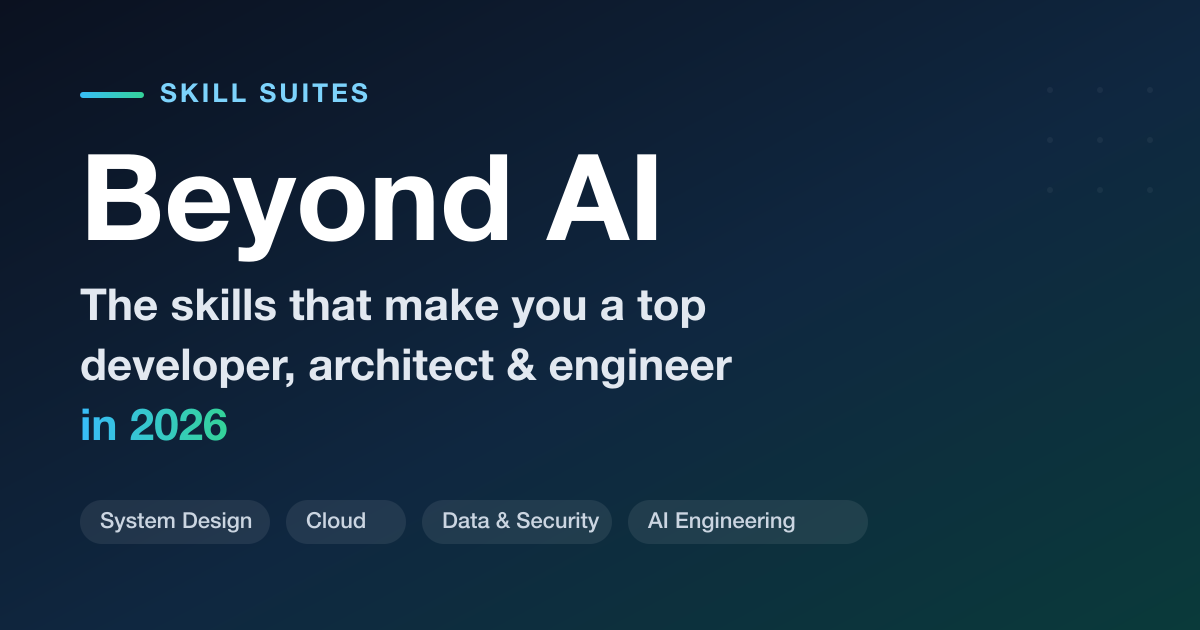
So if “learn AI” is the only line on your 2026 plan, you are optimizing for the exact thing everyone else is racing toward. The developers, architects, and engineers who become the top choice are the ones who pair AI fluency with a stack of durable, complementary skills. This article maps that stack in detail — and tells you what to prioritize for your specific role.
Key takeaways
- AI literacy is now table stakes, not a differentiator. It’s becoming as basic as knowing Git.
- The highest-leverage skill of 2026 is system design — because AI compresses the cost of writing code, raising the value of deciding what to build.
- The winning profile is “T-shaped”: deep in one or two areas, broad across fundamentals, cloud, data, security, and product sense.
- Your role changes the emphasis. Developers lead with shipping; architects with judgment; AI/platform engineers with data and reliability.
Why AI alone won’t make you a top choice
The job has shifted. The question is no longer “how do I write this code?” but “how do I architect this system?” — because AI now handles a large share of the syntax. That shift cuts both ways. It lowers the value of raw coding speed and raises the value of everything around the code: judgment, design, integration, security, and the ability to tell whether the machine’s output is actually correct.

AI is a force multiplier, and multiplying zero by anything still gives zero. A prompt-and-paste developer who can’t reason about system boundaries, data models, or failure modes will ship fragile software faster — which is worse, not better. The professionals who win are T-shaped: deep in one or two areas, broad across many. AI is one bar of the T. The rest of this article is the rest of the T.
The 8 skills that make you a top-choice engineer in 2026
Think of these as layers in a stack. AI sits on top, but it only delivers value when the layers beneath it are solid.
1. Software engineering fundamentals
What: Data structures, algorithms, clean code, automated testing, version control, and disciplined debugging.
Why it matters more now: You spend more time reading and reviewing generated code than writing it from scratch. If you can’t spot an off-by-one error, an N+1 query, or a subtle race condition in code an assistant produced, the assistant has made you slower and more dangerous, not faster.
How to build it: Review every line the AI writes as if a junior engineer wrote it. Write tests first. Learn your debugger properly instead of scattering print statements.
2. System design & software architecture
What: Designing for scale, latency, consistency, and failure; choosing between monolith, microservices, and event-driven designs; reasoning about trade-offs instead of memorizing patterns.
Why it matters more now: This is the single highest-leverage skill of 2026. AI can generate a service; it cannot decide whether you should build that service, how it behaves under load, or how it fits a ten-year roadmap. Architecture is where human judgment compounds.
How to build it: Study real-world architectures, draw the diagrams yourself, and practice defending trade-offs out loud. Our walkthrough on shipping a production AI microservice with FastAPI is a concrete starting point.
3. Cloud & DevOps
What: Containers (Docker), orchestration (Kubernetes), CI/CD pipelines, and infrastructure-as-code (Terraform, Ansible), plus at least one cloud platform (AWS, GCP, or Azure) at depth.
Why it matters more now: The market has moved past “I can deploy to a VM” toward “I can design auto-scaling, observable, reproducible infrastructure.” It’s an expectation, not a bonus.
How to build it: Containerize a real app, deploy it through a pipeline, and define the whole thing in code. Pair this with observability practices so you can actually see what production is doing.
4. Data engineering & databases
What: Deep SQL, data modeling, pipelines (Spark, dbt, Airflow), warehouses (Snowflake, BigQuery), and vector databases for retrieval.
Why it matters more now: The line between “developer” and “data” has blurred — companies increasingly want hybrid profiles who understand prompts, RAG, and pipelines. Modern AI runs on data plumbing, and vector stores are now core infrastructure.
How to build it: Model a non-trivial schema, build one ETL/ELT pipeline, and stand up a vector search index. See our guide on building a RAG-powered support agent.
5. Security & DevSecOps
What: Secure coding, secrets management, dependency and supply-chain hygiene, authentication patterns, safe remote access (SSH keys, least privilege) — plus AI-specific risks like prompt injection and over-permissioned agents.
Why it matters more now: The global cybersecurity talent gap runs into the millions, and DevSecOps — baking security checks directly into CI/CD — is now a baseline developer skill, not a separate specialty.
How to build it: Threat-model your own projects, rotate and vault your secrets, scan dependencies, and read the OWASP Top 10 (including the LLM edition).
6. AI engineering — done properly
What: The disciplined version of “AI skills” — prompt design, retrieval-augmented generation, tool use and agent orchestration, cost control, and — most underrated of all — evaluation.
Why it matters more now: Anyone can call an API. The top choice is the person who can measure whether the output is good, keep latency and cost in budget (for example with the Message Batches API), and ship AI features that are observable, testable, and safe.
How to build it: Build one real AI feature end-to-end with retrieval, tool use, and an eval harness — not a toy demo.
7. Product thinking & domain knowledge
What: Understanding the user, the business model, and the metric that matters — plus deep knowledge of a specific domain (fintech, health, logistics, dev tools).
Why it matters more now: Engineers who understand why they’re building something make better technical calls and get pulled into higher-impact work. Domain knowledge is a moat AI can’t easily cross, because it lives in context that’s rarely written down.
How to build it: Talk to users. Read the support tickets. Learn the unit economics of the thing you’re building.
8. Communication, writing & collaboration
What: Explaining a technical decision, writing a clear design doc, and collaborating with product and design.
Why it matters more now: Recruiters increasingly want developers who “think like architects.” The ability to specify a problem precisely — to a teammate or a model — is a superpower. Clear writing is clear thinking, and clear thinking is the thing AI still can’t outsource.
How to build it: Write design docs before you code. Blog about what you build. Practice the one-paragraph summary of any complex decision.
Skills by role: where to focus
The stack is shared, but the emphasis shifts with the title you’re aiming for. Use this as a quick prioritization guide:
| Skill | Developer / SWE | Architect | AI / Platform Engineer |
|---|---|---|---|
| Engineering fundamentals | Core | Core | Core |
| System design & architecture | High | Core | High |
| Cloud & DevOps | High | High | Core |
| Data & databases | Medium | High | Core |
| Security / DevSecOps | High | Core | Core |
| AI engineering (RAG, agents, evals) | High | Medium | Core |
| Product & domain sense | Medium | High | Medium |
| Communication & writing | High | Core | High |
The Developer / Software Engineer
Lead with fundamentals + AI engineering + one cloud platform. Be the person who takes a feature from prompt to production: write the code, wire up the AI feature, test it, containerize it, ship it through CI/CD. Add evaluation and observability so your AI features don’t silently degrade. Depth in one language ecosystem (Python, TypeScript, Go, or Rust) plus broad AI fluency makes you immediately hireable.
The Software Architect
Lead with system design + trade-off analysis + cross-cutting concerns (security, cost, scalability, data flow). Your value is judgment at the boundaries: which patterns, which services, which build-vs-buy calls, and how AI components fit a larger system without becoming single points of failure. Communication is non-negotiable — an architecture nobody understands is one nobody can maintain. AI literacy matters so you design with models, not around them.
The AI / Platform Engineer
Lead with data engineering + MLOps/LLMOps + security. You own the pipelines, the retrieval layer, the eval harnesses, the cost and latency budgets, and the guardrails. This is where the deepest AI skills pay off — but only on top of rock-solid data and infrastructure fundamentals. Knowing how to run agents reliably, cache aggressively, and evaluate continuously is what separates a demo from a product.
A practical 2026 learning roadmap
- Shore up fundamentals (ongoing). Don’t skip them to chase AI — they’re the soil everything else grows in.
- Pick one cloud and one language ecosystem and go deep. Breadth is for later; depth gets you hired now.
- Learn system design deliberately. Read real architectures, draw diagrams, defend trade-offs out loud.
- Build one real AI feature end-to-end — retrieval, tool use, evaluation, and a cost budget. Ship it, observe it, iterate.
- Add security as a habit, not a phase. Threat-model your own projects; treat secrets and access like they matter.
- Write about what you build. A clear blog post or design doc is the cheapest way to prove the communication skill everyone claims to want.
For a reality check on what tools developers actually use — versus what the hype cycle says — the annual Stack Overflow Developer Survey is hard to beat.
Frequently asked questions
Is it still worth learning AI in 2026?
Absolutely — but learn it as engineering (RAG, agents, evaluation, cost control), not as a buzzword. The point isn’t to skip AI; it’s that AI alone no longer differentiates you. Pair it with the durable skills in this article.
What is the single most valuable non-AI skill to learn?
System design and architecture. AI compresses the cost of writing code, which makes the human judgment of what to build and how it fits together the scarcest and most valuable skill.
Will AI replace developers who don’t upskill?
AI is unlikely to replace developers wholesale, but those who use AI well — and bring architecture, security, and product judgment — will out-compete those who only write code. The WEF projects a net gain of 78 million jobs by 2030 even amid heavy disruption. The risk isn’t AI; it’s standing still.
Which programming language should I learn in 2026?
Go deep in one ecosystem rather than dabbling in five. Python dominates AI and data work, TypeScript owns the web, and Go and Rust are rising fast for backend and infrastructure. Pick the one that matches your target role and master it.
Do I need to learn all of these skills at once?
No. Go deep on one or two (stay T-shaped), then broaden. Follow the roadmap: fundamentals, one cloud, one language, system design, one real AI feature, security as a habit.
Conclusion
AI is the most important new tool of the decade — and being only an “AI person” is a surprisingly crowded place to stand. The professionals who become the top choice in 2026 treat AI as one powerful layer on top of strong fundamentals, system design, cloud and DevOps, data, security, and product sense, all tied together by clear communication. Build that full stack of skills and you won’t just keep up with AI — you’ll be the person teams want building with it.
Ready to deepen the AI-engineering layer specifically? Start with our hands-on guides on agent orchestration patterns and evaluating AI apps in Python.